Many profitable SMEs still run on spreadsheets, two or three old programs that do not talk to each other, and a pile of emails handled by hand. It works, until the day growth turns every month-end close into an obstacle course. The good news: between the spreadsheet and the sprawling machinery of a global ERP, there is an often overlooked middle path.
Quick answer
A custom mini ERP for SMEs consolidates stock, purchasing, orders and invoicing in a single tool shaped around your real processes. It beats off-the-shelf software when your flows are too specific for a standard package, but too simple to justify a heavy, expensive ERP.
The tipping point: when the spreadsheet becomes a risk
The spreadsheet is not the problem. It is even an excellent starting point: free, flexible, known to everyone. The problem arises when it becomes the backbone of the company without having been designed for that role.
A few telltale signs:
- The same data (a product, a price, a stock level) is re-entered in several files, with discrepancies that inevitably appear.
- Only one person "knows" how to run the master file, and their absence paralyses part of the business.
- The monthly close takes hours of copy-pasting between exports from different programs.
- Nobody can answer a simple question live: what is my stock worth today, which orders are late, what margin do we make on this range.
When data is scattered, it ages quickly and becomes wrong. And a decision made on wrong data costs far more than the tool that could have made it reliable.
Custom or off-the-shelf: the real trade-off
The question is not ideological. Good off-the-shelf software (standard ERP, management suite) is often the best choice, and we say so honestly when it is. Here is how we decide.
Choose off-the-shelf software when...
Your processes are standard and will stay that way: conventional invoicing, Belgian VAT, cash register management, day-to-day accounting. On these well-trodden grounds, reinventing the wheel is a waste. A vendor spreading the cost of its product over thousands of customers will always do better and cheaper than a dedicated build.
Go custom when...
Your competitive edge lives precisely in a process the standard package cannot model: a particular replenishment logic, an approval chain specific to your trade, an atypical product bill of materials, a link between workshop and invoicing that no general-purpose tool captures. Forcing these flows into a standard ERP often means paying a lot only to... fall back on spreadsheets on the side to fill the gaps. You are then back to the original problem, only worse.
The custom mini-ERP occupies this in-between: it covers the core of your operations with your own rules, without the weight, licence cost and implementation complexity of a large ERP.
What a mini-ERP actually consolidates
The goal is to bring together into a single source of truth the building blocks that today live in separate files:
- Incoming goods and purchasing. Goods receipt, supplier purchase orders, real cost price. Data is entered once, at the entry point.
- Stock. A stock level that updates itself as receipts and sales come in, instead of an inventory frozen in a tab.
- Customer orders. From quote to delivery, with a status the whole team can read, without having to ask "where is this order at".
- Invoicing. Generated from the same data as the orders, which eliminates double entry and discrepancies between what is delivered and what is invoiced.
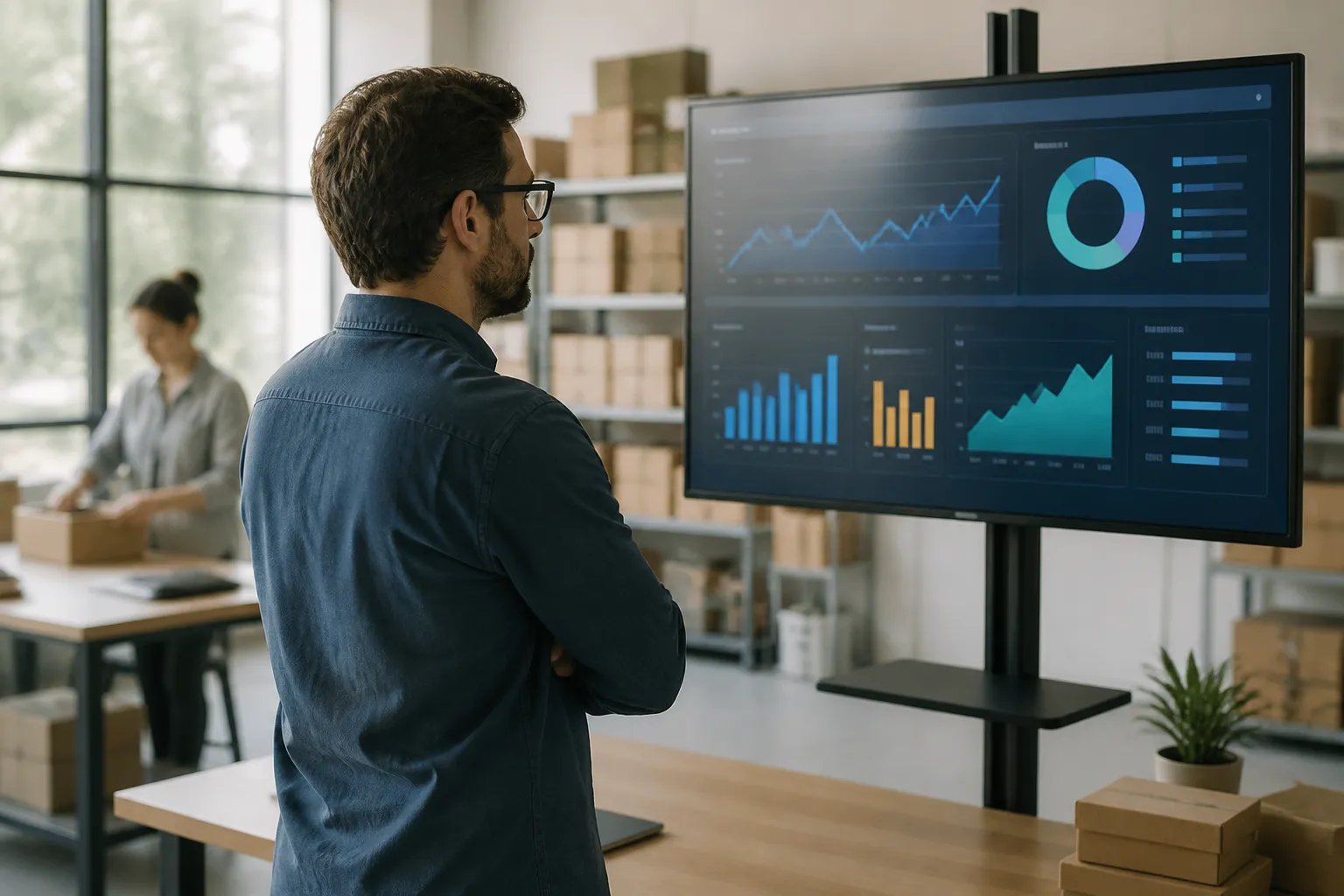
- Dashboards. A real-time financial and operational view: turnover, margins, tied-up stock, delays, top products. Management stops waiting for month-end to steer the business.
The gain is not just time. It is the end of contradictory versions of the same reality.
Our experience: a furniture SME
For a client in the furniture sector, a Belgian SME with annual turnover of around one million euros, the situation was typical: spreadsheets for stock and prices, old programs that did not communicate, and a lot of manual editing. A large part of the day went on handling emails by hand: confirmations, updates, reminders.
At itops, we designed a custom mini-ERP for this company, modelled on its real flows rather than on a generic template. The results speak for themselves.
About 90% of emails are no longer handled manually: repetitive cases are taken care of automatically, and people focus on exceptions. The management of incoming goods, stock, orders and invoicing is now centralised in a single tool, with financial and operational dashboards that give an immediate reading of the business.
Beyond the hours saved, the fundamental change is trust in the data. When the stock shown is the real stock, and the invoice flows automatically from the order, you stop checking, cross-checking, doubting. That peace of mind frees up time to sell and serve, rather than to administer.
We present results here, not a recipe: every context has its own business rules, and that is precisely why a tailor-made tool makes sense.
ROI, without kidding yourself
A mini-ERP is a real investment, and it should be looked at squarely. The return shows up on several levels.
Administrative time recovered. The hours spent re-entering, cross-checking and correcting are non-billable hours. Reducing them directly frees up capacity, without hiring.
Errors avoided. A stock error, a forgotten invoice, an order lost in an email thread: each has a cost, sometimes a customer. A single, automated flow makes these incidents drop.
Faster decisions. Steering on fresh data beats reconstructing the past. An anticipated stockout, an unprofitable range spotted in time, are often worth the tool on their own.
Independence. When knowledge is no longer locked in one person's head or a fragile file, the company becomes more resilient. That ROI is not easy to put a number on, but you feel it on the first day of unexpected absence.
The opposite trap exists too: over-investing. A mini-ERP is not meant to do everything from the start. Better a tool that solves three pain points perfectly than a sprawling platform that promises thirty and delivers none.
Scoping the project without over-engineering
Success is decided at the scoping stage, before the first line of code. A few principles we apply systematically.
Start from pain points, not features
We do not ask "which functions do you want", but "what costs you the most time and causes the most errors". The initial scope should fit on one page: the two or three processes that are bleeding, and nothing else.
Deliver in small, useful increments
A mini-ERP is built brick by brick, each one bringing immediate value. Stock consolidation before invoicing, for example. We avoid the big monolithic eighteen-month project that is delivered late and off target.
Respect the data and the Belgian framework
As soon as a tool centralises customer and commercial data, the GDPR applies: purpose, minimisation, security, access traceability. A well-designed mini-ERP builds these requirements in from the start rather than adding them afterwards. Depending on your sector and size, the NIS2 directive may also strengthen your obligations regarding system security.
Keep the door open
A good mini-ERP is designed to evolve. Once the data is clean and centralised, it becomes the foundation for more advanced capabilities: automatic document reading (OCR) for supplier invoice entry, electronic invoicing to European standards (PEPPOL), automatic payment reconciliation, or an internal assistant able to answer from your own data. These building blocks come afterwards, once the core is solid, never the other way round.
Frequently asked questions
Is a mini-ERP only for larger SMEs?
No. The trigger is not size but the complexity of the flows and the pain felt. A company of a few people whose processes are too specific for a standard package needs custom software more than a larger company with very conventional operations.
How long before we see a result?
With an incremental approach, the first useful building block (for example stock consolidation) can be in service within a few weeks. The mistake would be to wait until everything is finished: each module delivered must already relieve a real pain point.
What if our needs change in two years?
That is the main advantage of well-scoped custom software. Unlike a standard package where you are subject to the vendor's roadmap, a mini-ERP evolves with your business. The condition is to have built clean, documented foundations from the start.
Is it compatible with mandatory electronic invoicing?
Yes, and it is even a strong argument. Since electronic invoicing is spreading across Europe, starting from data that is already centralised and structured makes it easier to adopt standards such as PEPPOL, whereas scattered spreadsheets make compliance painful.
Sources
- Data Protection Authority (DPA), the Belgian GDPR authority: autoriteprotectiondonnees.be
- General Data Protection Regulation (GDPR), official European Union text: eur-lex.europa.eu
- NIS2 Directive on the security of network and information systems: eur-lex.europa.eu
- PEPPOL, European framework for exchanging electronic documents (invoicing): peppol.org
At itops, we help Belgian SMEs decide, honestly, between off-the-shelf and custom software, then scope a mini-ERP that solves the real pain points without over-engineering. A short audit is often enough to see clearly, and we train your teams so they stay in control of the tool.