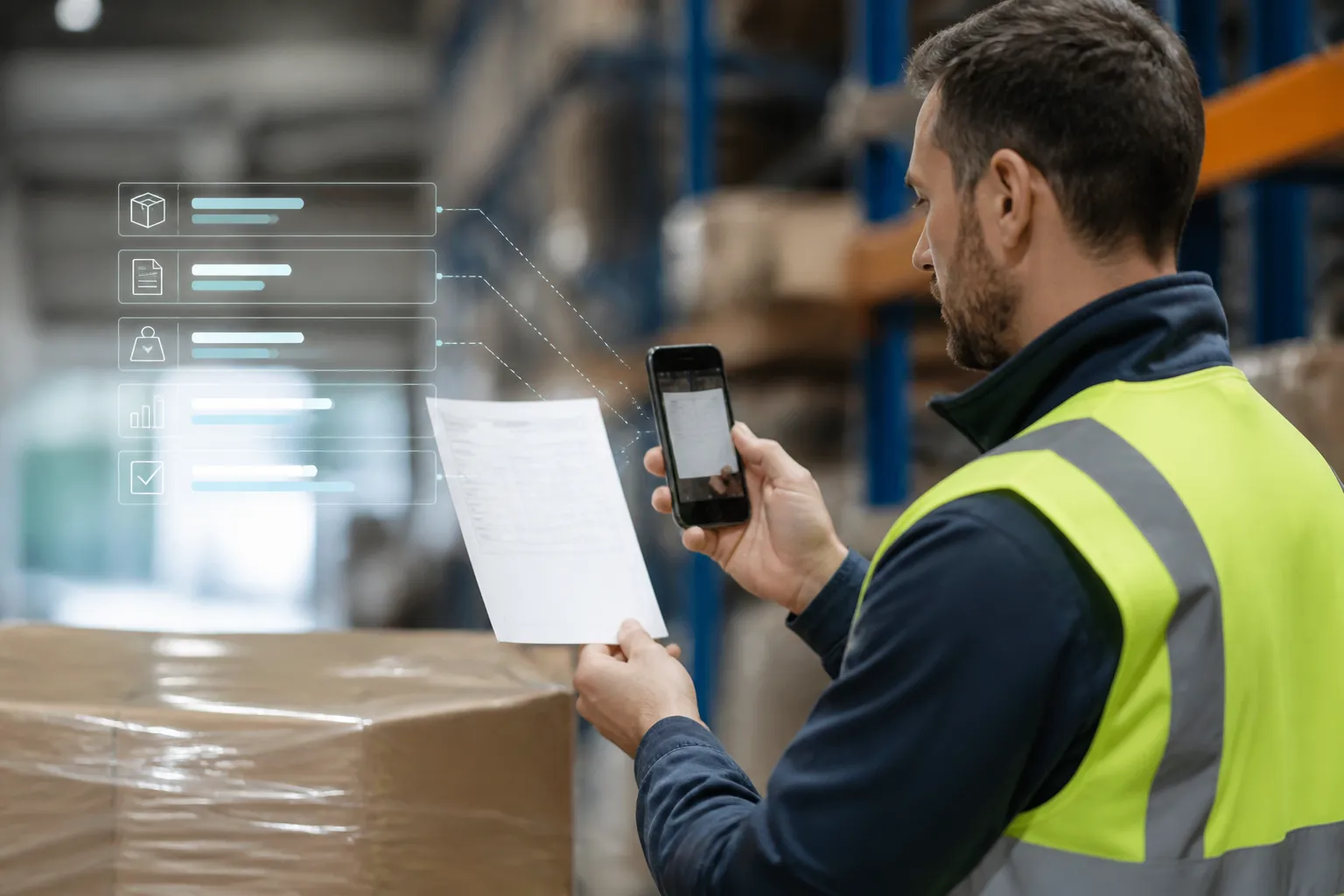
Manual stock entry remains one of the most time-consuming and frustrating tasks in an SME. A delivery note arrives, someone deciphers the lines, copies the references into the management software, fixes the typos, then starts over with the next delivery. Every data entry error is paid for later: an item that cannot be found, a wrong inventory, a blocked customer order. Combining optical character recognition (OCR) with artificial intelligence radically changes this routine. The idea is simple: you take a photo, the system reads, understands and proposes. All you have to do is validate.
Quick answer
OCR combined with AI turns a photo of a delivery note or a product into structured inventory entries. The system recognises the items and proposes a list ready to be injected into stock. A human validates or corrects: no more manual re-entry.
What AI-driven OCR really does
Classic OCR has been around for a long time: it converts an image of text into usable text. On its own, it quickly runs into the reality of the field. A crumpled delivery note, handwriting, a layout that changes from one supplier to the next, a photo taken at an angle in a poorly lit warehouse: raw OCR then returns a jumble of characters that is hard to use.
This is where AI comes in. Instead of merely reading characters, a layer of artificial intelligence interprets the document. It distinguishes a product reference from an order number, matches a description to a quantity, spots the unit of measure, and links everything to an item already known in your catalogue. We move from reading to understanding. The result is no longer a block of text, but a list of candidate items, each with its likely reference, quantity and description.
Applied to a photo of a product rather than a document, the same logic recognises an item from its appearance, packaging or label, and proposes the matching record. In both cases, the principle is the same: capture an image, extract meaning from it, produce a structured proposal.
The key pattern: the system proposes, the human validates
The most important point is not the technical performance of the recognition. It is the place left for the human. A good AI-assisted inventory system never tries to write directly into your stock without supervision. It works according to a pattern known as human in the loop: the machine does the tedious work, the person keeps the final decision.
In practice, the user receives a pre-filled list. Each recognised line is displayed with the proposed reference, quantity and description. The operator goes through the list, confirms what is correct, adjusts a quantity, fixes a misread reference, discards a stray line. In a few gestures, the stock entry is validated and injected into the management software.
This pattern has three decisive advantages. First, it eliminates re-entry: nobody copies dozens of lines by hand any more. Second, it maintains human quality control over every entry, which reassures the team and the manager alike. Finally, it makes the system tolerant of its own mistakes: even if the recognition gets a line wrong, human validation catches the error before it pollutes the inventory.
At itops, what we have observed in the field
For a Belgian SME in the furniture sector, we integrated OCR and AI recognition directly into its goods receipt flow. The way the client wanted it to work was deliberately simple: the user photographs the incoming products or the delivery note, the system identifies the items and proposes a list to inject into the inventory. The operator only has to validate what the system has recognised.
The most visible change was the disappearance of manual re-entry of stock receipts. Where a receipt previously meant deciphering a document and then copying each line into the software, the team now simply takes a photo and reviews a proposal. The time spent on data entry has dropped markedly, and the team's energy has shifted to higher-value tasks: checking the condition of the goods, organising storage, serving customers.
We present results here, not a recipe. The transferable lesson lies elsewhere: this type of gain does not require overhauling an entire information system. It is enough to insert a recognition step at the right point in the existing flow, keeping the human as final validator.
Where it fits: goods receipt and stock management
Not every stage of an inventory lends itself equally well to this kind of automation. The best entry point is almost always goods receipt, known as goods-in.
Goods receipt
This is the moment when information enters the system, and therefore the moment when an error costs the most over time. A photo of the delivery note or the pallets received, a proposal of entries, a validation: the flow is short and the benefit immediate. It is also the most repetitive stage, the one that tires teams the most, and therefore the one where AI assistance is most appreciated.
Day-to-day stock keeping
Beyond receipt, the same mechanism helps keep stock up to date: counting a shelf by photo, checking a batch, quickly identifying an item whose label is damaged. Visual recognition becomes a field tool, usable directly from a phone, without going through a workstation.
Where caution is needed
On the other hand, anything involving accounting valuation, financial entries or sensitive movements must remain under strict control. OCR proposes an inventory data point; it does not replace a management decision. The rule remains constant: the machine prepares, the human decides.
Accuracy, error handling and trust
One question always comes up: can you trust what the machine reads? The honest answer is nuanced. Recognition performs very well on legible documents and well-labelled items, and is more fragile on handwriting, blur or unusual layouts. That is precisely why the human validation pattern is not an option, but the heart of the system.
A well-designed system does not just propose: it flags its own level of certainty. A line recognised without ambiguity can be validated at a glance, while a doubtful line is highlighted to draw the operator's attention. The human then concentrates effort where it counts, instead of rechecking everything uniformly. It is this collaboration, not blind trust, that produces a reliable inventory.
Error handling thus becomes a learning process: each correction made by the operator gradually refines the quality of the proposals, especially for recurring suppliers and items. The system becomes more accurate precisely where your activity is densest.
Time saved, measured the right way
The time saving is real, but it cannot be reduced to a stopwatch on a single operation. It must be measured across the whole cycle. Manual entry is slow, but it also generates errors, and those errors later trigger searches, corrections and disputes. By removing re-entry and filtering errors at validation time, AI-driven OCR reduces both the initial entry time and the hidden cost of later corrections.
For an SME, the most tangible effect is often human before it is quantified: a tedious, demotivating task disappears. Receiving teams spend less time at a keyboard and more time on what makes sense. In the long run, this regained time is as valuable as the minutes saved on each delivery note.
A word on data and compliance
A delivery document contains commercial information, sometimes personal data (a driver's name, a contact's details). As soon as an image is captured, read and stored, it falls within the scope of the GDPR. A Belgian SME has every interest in knowing where these images are processed, how long they are kept and who can access them.
Good practices are classic but essential: limit collection to what is strictly necessary, define a retention period, log access, and favour processing whose location and hosting are under control. AI recognition is not a reason to relax rigour on data protection: on the contrary, it is an opportunity to formalise it properly from the design of the flow.
Frequently asked questions
Do you need special equipment to photograph products or delivery notes?
No. A simple recent smartphone is enough in the vast majority of cases. The quality of the photo matters more than the equipment: sharp framing, good lighting and a flat document give the best recognition. The point of the system is precisely to work with the tools already available in the field.
What happens if the system misrecognises an item?
Nothing serious, because no entry is written into stock without human validation. The operator corrects the line in question before validating, exactly as they would adjust a manual entry. The difference is that they correct instead of retyping everything. Repeated corrections also improve the quality of future proposals.
Does this approach suit small organisations?
Yes, and it is often where it helps the most. Small teams have no staff dedicated to data entry: every minute spent re-keying stock is taken from something else. Automating recognition while keeping a simple human validation gives time back without requiring any particular technical skill.
Does AI replace the warehouse worker?
No. It removes the tedious part of their job, the copying, to leave them the part that requires judgement: checking, deciding, organising. The warehouse worker remains the final validator and the guarantor of inventory quality. The tool assists them, it does not replace them.
Sources
[1] Data Protection Authority (APD/GBA), practical guides on the GDPR and data minimisation, autoriteprotectiondonnees.be
[2] European Commission, General Data Protection Regulation (GDPR), official text, eur-lex.europa.eu
[3] European Commission, Artificial Intelligence Act (AI Act), eur-lex.europa.eu
Need to insert OCR and AI recognition into your receiving flow, or to train your teams on this type of tool without losing control of your data? The itops team supports Belgian SMEs, from the initial audit to AI training for your teams.