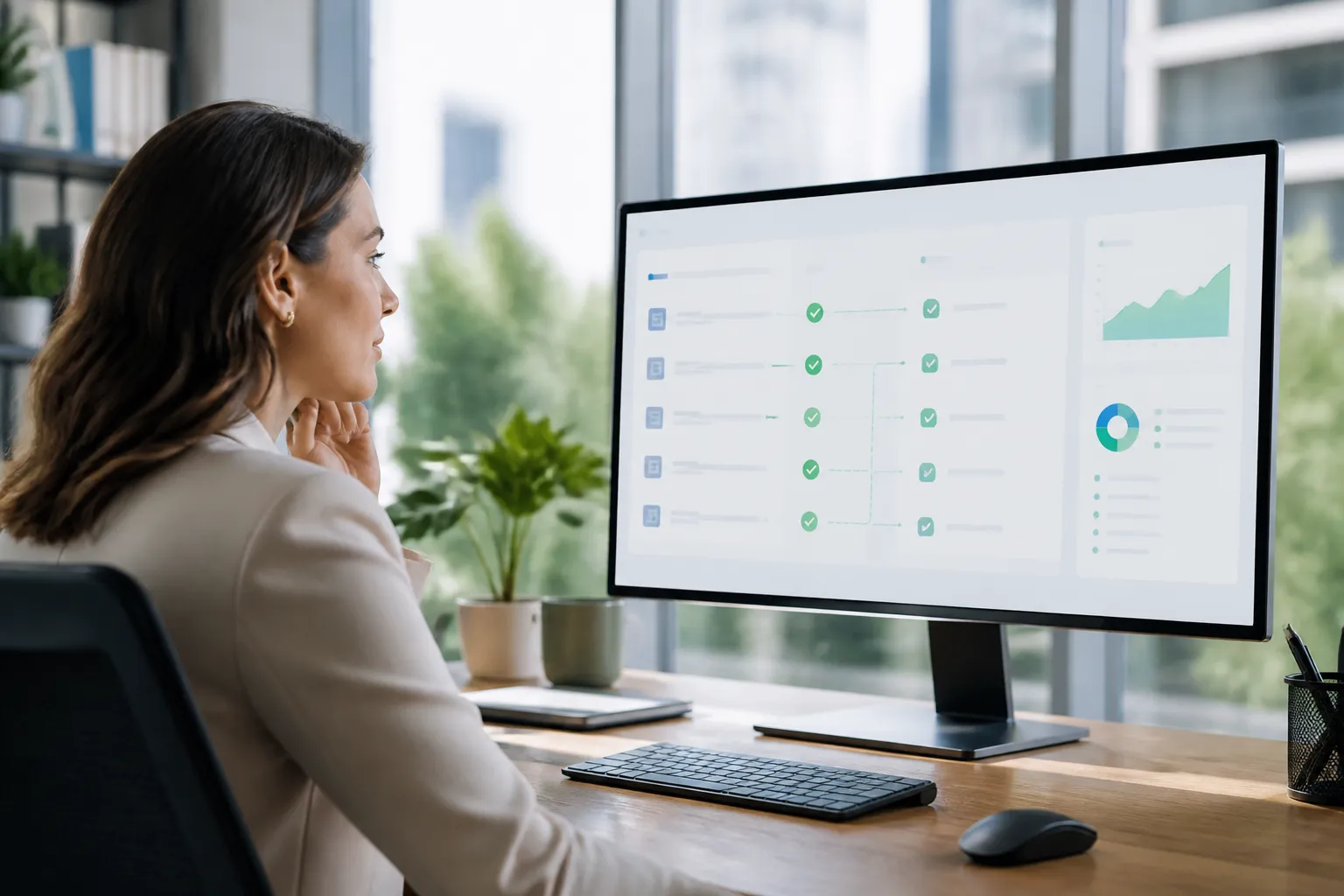
Every month-end, the same chore comes back: open the bank statement, compare it with the invoices issued, tick off who has paid, chase the late payers and correct data-entry errors. For many SMEs, this manual reconciliation eats up hours that create no value. The good news: it is now possible to request payment online and let the matching happen on its own, without ever having to track by hand what has been settled and what has not.
Quick answer
Automatic payment reconciliation links an online payment gateway to your management software. You send an invoice that can be paid online, and as soon as payment is made, the transaction is automatically matched to the right invoice. No more manual ticking off, and cash flow visible in real time.
The real cost of tracking payments by hand
In an SME, tracking incoming payments often relies on one person, a spreadsheet and a lot of memory. This works as long as volumes stay low, then it breaks down. Three problems come up systematically.
First, wasted time. Matching each transfer against each invoice, finding the reference of a customer who labelled their payment wrongly, correcting a partial amount: these micro-tasks pile up and eat whole days over the year.
Second, errors. A payment assigned to the wrong invoice, a settlement overlooked, an amount copied incorrectly. Each error distorts the accounts and can trigger an unjustified reminder that annoys a good customer.
Finally, the cash-flow blind spot. When reconciliation is done once a week, or even once a month, you are steering with outdated data. You do not know, at any given moment, how much you still have to collect or who is late. For a small business, this fog can be costly.
On top of these three problems comes a risky dependency. When all the tracking rests on one person and their spreadsheet, an absence, a departure or a simple oversight puts the whole process at risk. The knowledge is neither shared nor documented: it lives in one head. Automating the matching also makes the process explicit, traceable and transferable, independent of individuals.
How automatic payment reconciliation works
The principle is simple to grasp, even without a technical background. It rests on two building blocks that talk to each other: your management system (where your invoices live) and an online payment gateway (the service that collects payment for you).
Requesting payment online
Everything starts when the invoice is issued. Instead of sending a plain PDF with your bank details, you attach a payment link or button. The customer pays in a few clicks, by card or by another method offered by the gateway. The experience is smooth on their side, and you remove the friction that delays payments.
Each payment request carries a unique reference tied to the original invoice. It is this reference, invisible to the customer, that makes automatic matching possible.
Matching the transaction without intervention
As soon as the payment goes through, the gateway notifies your management system. Thanks to the reference carried by the transaction, the tool identifies the invoice concerned and marks it as paid, with the exact amount and date. No data entry, no ticking off: the invoice moves from "pending" to "settled" by itself.
Special cases are handled cleanly. A partial payment reduces the remaining balance due. An overpayment is flagged. A transaction with no clear match is set aside for checking, rather than matched at random. The automation handles the normal flow and draws your attention only to the real exceptions.
What this changes in practice for an SME
The benefits show up quickly, and not only in hours saved.
Cash-flow visibility becomes permanent. At any moment, you know what has been collected and what remains to be recovered, on data that is up to date to the minute. This clarity eases decisions: making a purchase, hiring, negotiating with a supplier.
The administrative load melts away. Reconciliation, which used to take up hours, disappears from the daily routine. The time freed goes back to tasks that add value: customer service, business development, production.
Payment times get shorter. A customer who can pay in two clicks pays faster than one who has to re-enter an IBAN. The payment link removes a friction and mechanically improves the average collection time.
Data-entry errors fade away. The data comes straight from the transaction, with no human re-keying. The accounts become more reliable and period-end closings run more smoothly.
Customer relationships improve too, quietly. A customer who receives a clear invoice, payable online, and who is never chased by mistake for an amount already settled, keeps a professional image of your company. Conversely, an unjustified reminder sent to a good payer leaves a lasting impression. By making reconciliation reliable, you also protect the quality of your business exchanges.
Our experience
For a Belgian SME, we connected an online payment gateway to its management system. In practice, the team now requests payment of an invoice directly online, and as soon as the customer pays, the transaction is automatically matched to the corresponding invoice. Nobody tracks by hand what is paid or not any more: the system takes care of it. As a result, the person who used to spend a significant amount of time on matching has been able to refocus on their core job, and management has a reliable view of its cash flow without waiting for the period-end close. We present the results achieved here, without going into the technical details of the implementation.
Points to watch before you start
An automatic reconciliation project remains an integration project. A few questions are worth asking upfront to avoid nasty surprises.
The compatibility of your management tool comes first. Can it receive payment notifications and expose its invoices to an external service? Most recent software allows it, but not all are equal. A quick audit avoids building on a fragile base.
The choice of gateway matters too. Payment methods offered, per-transaction fees, quality of technical notifications, compliance: compare these criteria before committing. The goal is a reliable service that informs your system in a predictable way.
Exception handling must be thought through from the start. What happens in the case of a refund, a dispute, a payment that cannot be found? A good setup anticipates these situations and defines who handles what, rather than discovering them in production.
Finally, data protection frames the whole. Payment data is sensitive and falls under the GDPR. In Belgium, the Data Protection Authority oversees its proper handling, and serious providers meet the sector's security standards. Choosing compliant players and limiting the data you handle yourself durably simplifies your exposure.
Where to start
There is no need to automate everything at once. The safest approach is to map your current flow: how an invoice is born, how it is sent, how a payment is recorded today. This snapshot reveals the friction points and the real gain to expect.
Then, a pilot on a limited scope (one type of invoice, one customer segment) lets you validate the automation without risk before rolling it out. You measure the results, adjust the matching rules, then extend gradually. That is how an automation project keeps its promises instead of remaining a good intention.
Frequently asked questions
Do I need to change my management software to automate reconciliation?
Not necessarily. Many current management tools can receive payment notifications and expose their invoices. A compatibility audit tells you whether you simply need to connect a gateway or consider an upgrade. We always start from what you already have.
Does automatic reconciliation handle partial payments?
Yes. A partial payment reduces the remaining balance due on the invoice concerned, and an overpayment is flagged. Transactions with no clear match are isolated for checking rather than matched at random, which protects the reliability of your accounts.
Is this reserved for large companies?
No, it is even particularly profitable for an SME. Small businesses suffer most from manual tracking, lacking dedicated staff. The return on investment is often quick, measured in administrative hours saved each month.
Is this payment data GDPR-compliant?
It is if you rely on compliant providers and limit the data you process directly. In Belgium, the Data Protection Authority oversees this processing. Delegating collection to a serious gateway reduces your own area of responsibility.
Sources
[1] Data Protection Authority (APD), Belgium, autoriteprotectiondonnees.be
[2] General Data Protection Regulation (GDPR), official text, gdpr.eu
Need clarity on your invoicing and collection flow? At itops, we audit your management system and help you connect online payment to your tool, in full compliance.